
The Faces Behind the Mystery
An early twentieth-century photograph, three mysterious figures, and the stories a camera cannot tell.
Some photographs barely make us pause. Others, for reasons we cannot quite explain, seem to ask us to stay a little longer.
This is one of them.
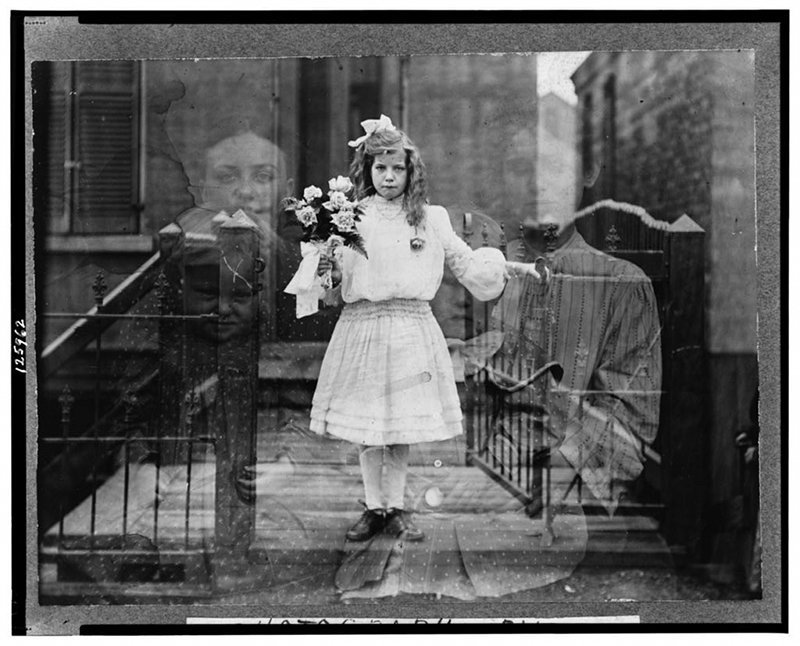
A young girl in a pale dress, holding a bouquet of flowers, with the solemn expression so often found in old photographs. Behind her, however, something seems out of place. Two adults and another child appear almost transparent, as though someone had decided to photograph what is there and what should not be there at the very same time.
The photograph dates from around 1905 and is attributed to G. S. Smallwood, a photographer from Chicago. Today, it belongs to the Library of Congress collections, where it is catalogued as a double-exposure “spirit” photograph.
Well, that seems to settle the mystery.
What a shame. I hadn't even had time to come up with an unlikely theory.
I've always been fascinated by the paranormal, by unexplained phenomena, by the presences some people claim to have encountered and others dismiss with a perfectly rational explanation.
That doesn't mean I believe everything I'm told. Father Christmas, for instance, had his moment of glory. We parted ways quite a few years ago.
The point is something else entirely: I like to think there may be more to existence than what we already know.
And among countless photographs, this one immediately caught my attention.
Of course, I know what double exposure is. Long before digital photography, film cameras could produce overlapping images, either accidentally or through a deliberate choice by the photographer.
I still remember a photograph my father took of my cousin when she was little. Behind her, a vase of flowers appeared superimposed on the image. It was beautiful. No editing software, no artificial intelligence. Just a film camera and an unexpected effect that turned an ordinary moment into something special.
So I have no difficulty accepting the technical explanation for Smallwood's photograph.
But understanding how something was made doesn't make me any less curious.
Quite the opposite.
By the beginning of the twentieth century, spirit photography had already captured the public imagination. Photographs that appeared to reveal invisible presences could be interpreted as evidence of a world beyond the material one. Double exposure made it possible to create transparent figures, seemingly suspended between two realities.
To some, they were proof. To others, illusions.
And photography became the perfect setting for a question that still follows us today: how much can we trust what we see?
Yet when I looked at this photograph, I found myself asking something different.
Who were these people?
Who was the little girl holding the flowers? And who were the figures behind her? Did they know one another? Were they related? Or were they simply people photographed separately, later brought together through a photographic technique?
We don't know.
The available catalogue information identifies the photographer and describes the image, but tells us nothing about the lives of the people pictured.
And that is precisely what intrigues me.
If I could meet Smallwood, I probably wouldn't ask how he created the photograph. I'd ask who had stood in front of his camera. Why that particular girl? Why those figures? What story was he trying to tell?
Perhaps he'd say it was nothing more than a photographic experiment.
A perfectly reasonable answer. And a terribly unsatisfying one.
It reminds me of The X-Files. I've always wanted to be Dana Scully. Rational, methodical, ready to look for a scientific explanation.
But then a photograph like this comes along, and I discover that my brain has already requested a transfer to Fox Mulder's office.
I want to believe.
Not necessarily everything people tell me, but that there may be things we are not yet capable of understanding.
That doesn't make every unusual photograph evidence of the supernatural. Nor does it turn a photographic effect into proof that invisible entities exist.
It simply means I don't believe our knowledge of the world is a book whose final page has already been written.
Perhaps that's why images like Smallwood's can still fascinate us more than a century later.
Not only because they show something unusual, but because they remind us how readily we imagine stories behind what we cannot immediately explain.
And then there are the people themselves.
Those who stood before the camera, who lived in a time so far removed from our own, who had ordinary days, loved ones, worries and dreams we may never know anything about.
Today, we look at them and wonder whether we are seeing mysterious presences, illusions, or simply two photographs combined into one.
But before they became a mystery to us, they were people.
Perhaps that is what strikes me most.
A camera can create the illusion of a presence. It can overlap two moments, blur their boundaries, and turn a face into something that seems to emerge from another world.
But a camera alone cannot tell us who that face belonged to.
And so I keep looking at the little girl holding the flowers.
She doesn't frighten me. The photograph doesn't unsettle me.
It makes me want to know more.
Because I like believing there may be something beyond the tangible world. But I find it just as fascinating to imagine how many real stories might be hidden behind an apparently impossible image.
And perhaps not every mysterious photograph needs to make us believe in invisible entities.
Sometimes, it is enough to make us want to know the people.
Image: G. S. Smallwood, c. 1905. Library of Congress, Prints and Photographs Division. Reproduction number: LC-USZ62-125962.
Archival reference: https://www.loc.gov/pictures/item/00650172/
 Print
