
Before the Water Lilies, Monet Had a Sense of Humour
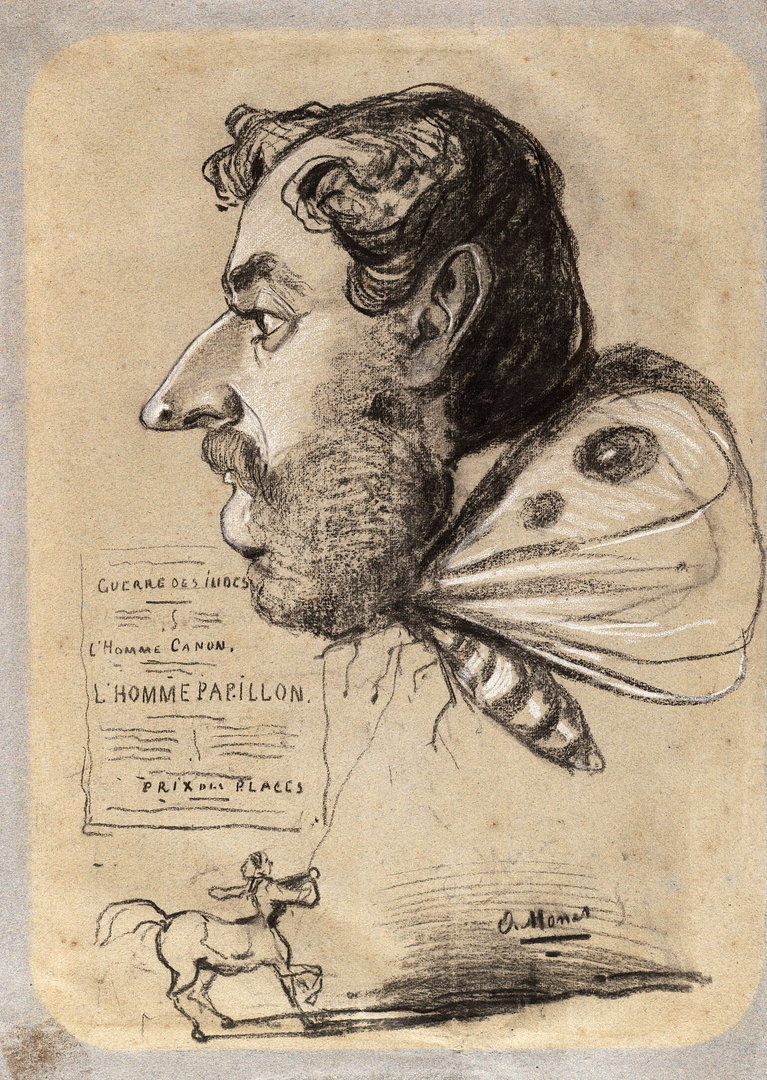
L’Homme Papillon, c. 1858 — The unexpected, playful side of Claude Monet before Impressionism.
When we think of Claude Monet, we immediately picture water lilies, the gardens of Giverny, and sunlight dancing across the surface of a pond. Paintings so peaceful they almost seem to belong to a world where nobody has ever had a bad day.
And yet, long before becoming the painter who would transform the way we see landscapes, Monet had a rather less contemplative occupation: drawing caricatures.
And, apparently, he was quite good at making fun of people.
It was around 1858. Monet was still a teenager, living in Le Havre, with none of his future masterpieces to his name. But he had already developed a remarkable talent for observing people, identifying their most distinctive features, and turning them into witty, sometimes grotesque drawings.
His caricatures attracted attention, and people were even willing to pay for them. Before conquering museums, Monet had already discovered an audience.
Among these early works is L’Homme Papillon — The Butterfly Man — a caricature of Jules Didier.
A human figure transformed into a peculiar creature, somewhere between elegance and absurdity. An image that seems to belong more to the world of satire than to the future of Impressionism.
And that is precisely what makes it so fascinating.
We tend to imagine great artists as though they were born destined for greatness. In our minds, Monet practically arrived in the world holding a paintbrush, with a water lily conveniently waiting in front of him.
The reality, of course, was rather different.
Before finding his artistic direction, he experimented, observed, and enjoyed himself.
Caricature demands a particular skill: the ability to recognise what makes a subject instantly distinctive. In a different form, that sharpness of observation would remain central to Monet's work.
His artistic language would change dramatically. Exaggerated faces would give way to landscapes, shifting atmospheres, and fleeting impressions of light. Yet his fascination with the visible world would endure.
L’Homme Papillon reminds us of something we often forget when standing before a masterpiece: behind every celebrated artist is a person who experimented, made mistakes, changed direction, and occasionally did something simply because it was fun.
Before the water lilies, before the museums, and before becoming Monet with a capital M, there was a young man drawing butterfly people.
And perhaps that is the most delightful detail of all.
Even the greatest artists, before becoming immortal, were wonderfully human.
Marika Sangalli
Essay Editor — Wrackline
 Print
